
How acoustics evolved
How architecture and surroundings shape the way we listen
What do Milan's Teatro degli Arcimboldi and its Arena Civica have in common? Or Florence's Nelson Mandela Forum and its Teatro Verdi? On the face of it, nothing: they were built in different centuries for different purposes.
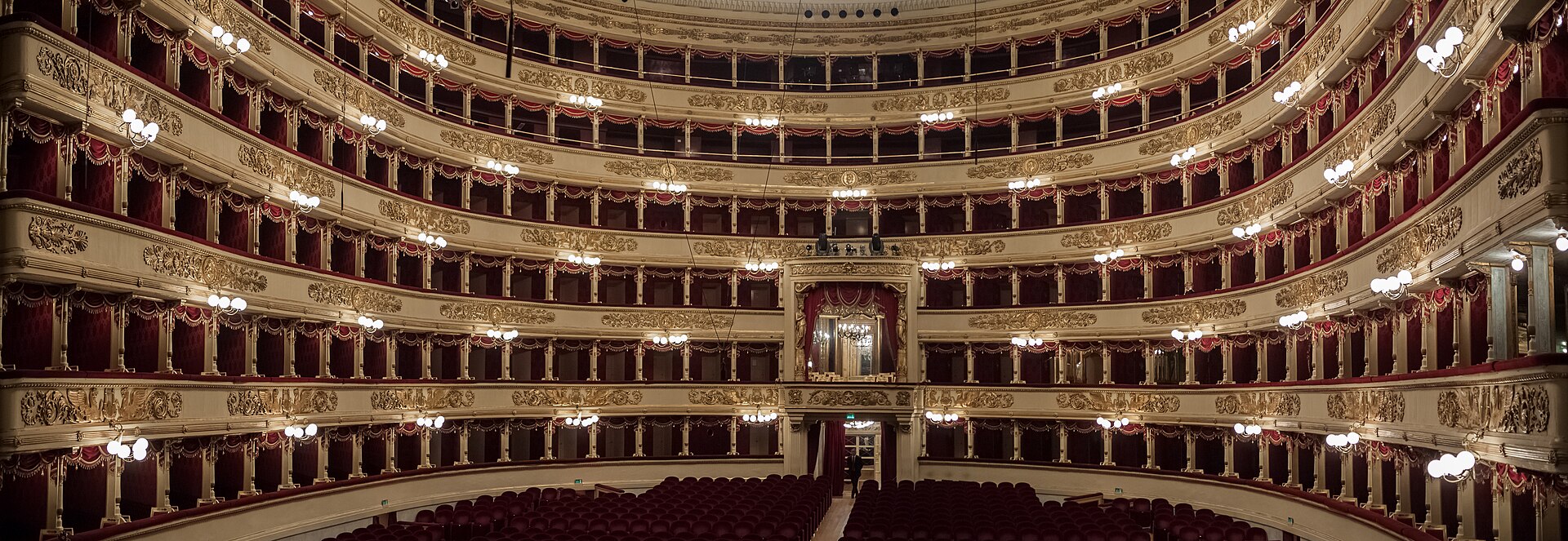
Yet there are musicians who have played all four. Take one of Italy's biggest names, Vasco Rossi. His stadium records speak for themselves (at Modena Park, on 1 July 2017, 225,173 tickets were sold), not to mention the arenas and the big open-air shows. In 2012 his songs even made it into La Scala, Milan's opera house: not as a concert, but as L'altra metà del cielo, a ballet by Martha Clarke built on his songs, rearranged by Celso Valli.
The difference is obvious the moment you listen: the Vasco of La Scala sounds nothing like the usual one. An opera house does not lend itself to loud, distorted performances, and it has nothing to do with the sanctity of the place: it is a matter of acoustics. Beyond the artistic choice of giving some songs an orchestral dress, the arrangements would have had to adapt anyway.
Picture Led Zeppelin in a church. The naves produce a long reverb, the sound scatters beyond control, and the result would be an acoustic mess of rare proportions. And mind you, it is not about volume.
So why does a church sound like that?
Wide naves and soaring ceilings were there to spread the voice in an age when the microphone was not even science fiction. Even a Mozart performance would struggle in there: the quick, articulated phrasing would blur into too many overlaps (there is more on reverb in Io rifletto, in Italian). Bach, on the other hand, wrote music that mirrors the buildings he worked in: for twenty-seven years, from 1723, his organ filled the Thomaskirche in Leipzig, a vast hall that suited the solemn cadences of his writing perfectly.
More generally, European art music is less percussive than many musics born outdoors, in many West African traditions for instance: noisy settings, far less formal than an opera house, where the audience joins in and dances. There, singing and clapping sit on top of the performance, and the music is built to carry it: rhythm, repetition, a voice that calls and a chorus that answers.
The rock bands of the fifties and sixties experimented with distortion for a similar reason. It produced powerful, complex sounds that stayed recognisable in small, packed clubs full of people dancing and singing, that is, with a background noise to rise above. On top of that, professional recording was taking music into new places, such as flats and dance halls.
If architecture shapes how sound travels, and therefore how we listen, it is just as true that the sounds that spread over the years come from the places where they were conceived and performed.
Nature, as usual, offers a fine example. In 2003 two biologists in Leiden, Hans Slabbekoorn and Margriet Peet, recorded the songs of 32 male great tits around the city: the ones holding territories near busy roads sang with a higher minimum pitch than the others. Urban noise sits almost entirely in the low frequencies, so the song moves up to avoid being masked. An adaptation with a single goal: being heard more clearly.

The same goes for us. Digital files and mp3s moved listening into the earbuds of a smartphone, and that changed how producers and mix and mastering engineers work: some frequencies get favoured, others tucked away, so the sound travels as well as possible on the new medium. In 2012 Apple launched a dedicated programme, Mastered for iTunes, renamed Apple Digital Masters in 2019; and today streaming platforms normalise loudness, so a master pushed to the limit no longer sounds louder than the rest (more on that in How do we measure music?).
From the nave to the earbud, the rule has not changed: music takes the shape of the place where you listen to it.
This piece is a revision of an article from March 2018. The story of Vasco at La Scala has been corrected (it was a ballet built on his songs, in 2012), the Leiden study has been added with its source, and so has what happened next with streaming.
Alessandro Porri
More of these, here.
All articles →