
How do we measure music?
Finding your way through a maze of units
You know sound is measured in decibels. What you may not know is that the decibel was never meant to measure sound.
A decibel isn't a unit like the metre or the watt. It's a ratio: it tells you how many times bigger one quantity is than another, taken as a reference, and it says so on a logarithmic scale. That's why it turns up in electronics, telecoms and chemistry too. And that's why, on its own, it means nothing: "30 dB" only makes sense once you know compared to what.
Born on the telephone line
In the early twentieth century telephone engineers had a practical problem. The signal lost strength along the line, and that loss had to be measured. They measured it in "miles of standard cable": how far the voice would have to travel down a reference cable to fade that much.
In 1924 Bell Telephone Laboratories replaced it with a new unit, the transmission unit, based on the logarithm of the ratio between two powers. In 1928 it was renamed the decibel: one tenth of a larger unit called the bel, after Alexander Graham Bell. The bel on its own was too coarse for the everyday differences engineers dealt with, and a tenth of it gave handy numbers. Hardly anyone uses the bel at all.
Twice as loud is not +3
With power ratios the rule is simple: every 10 dB, the power goes up tenfold. The ratio between a tonne and a kilo, a thousand to one, is 30 dB. And doubling a power is worth about 3 dB.
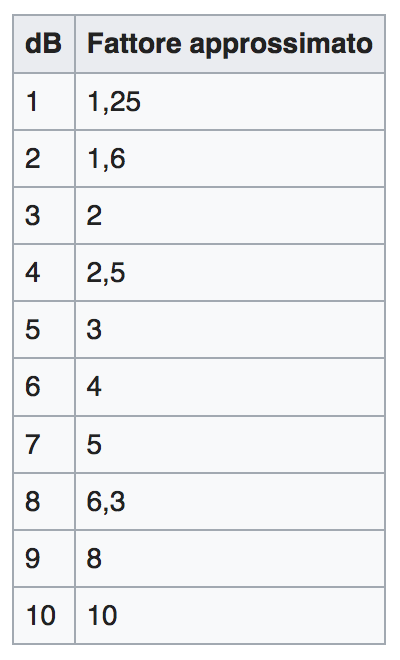
This is where the original 2018 article slipped. It said that to hear your amp play twice as loud you just turn it up 3 dB. It doesn't work that way, and it's worth saying why. Those 3 dB double the power. Look at the signal's voltage instead, and double is 6 dB. Your ear is a different story again: for a sound to seem twice as loud you need about 10 dB more, which is ten times the power. Three ways to say "double", three different numbers.
The tape sweet spot
Since the decibel wasn't made for music, every corner of audio ended up with its own reference: dBu, dBV, dBm, dB SPL, dB(A), dBFS. The plot thickens.
On tape, the engineer had to find the right spot. Too low and hiss covered everything; too high and the tape distorted. The VU meter, born in 1939 from joint work by Bell Labs, CBS and NBC for radio lines, became the tool for finding it. In professional studios, zero on that scale, 0 VU, equals +4 dBu, about 1.23 volts.
Digital and full scale
Digital brought the dBFS, decibels full scale. This time zero is the same for everyone: 0 dBFS is the highest value the converter can write, and everything else sits below it, in negative numbers. What changes from studio to studio is something else: how many dBFS the old 0 VU lines up with. In Europe the EBU recommendation puts it at -18 dBFS, in the US the SMPTE standard at -20.
Above zero, though, digital is unforgiving. Push a tape too hard and it saturates gently, and that distortion made rock what it is. A converter that goes past 0 dBFS chops the waveform flat, and the result is a crunch nobody wants. On the other hand, at today's 24 bits recording a little lower costs you almost nothing: the noise floor is a long way down.
What has changed since
In 2018 the article was missing the measurement that matters most today to anyone releasing music: LUFS. It doesn't track peaks but perceived loudness, weighting frequencies the way the ear does. European broadcasters have used it since 2010 (EBU R128, -23 LUFS), and streaming platforms normalise tracks to a similar value: Spotify, for one, brings everything to around -14 LUFS. So a master pushed to the limit no longer sounds louder than the rest. It gets turned down, and often loses out.
One more unit, then. But it's the first one that tries to measure what we hear, rather than what runs down the cables.
This piece is a revision of an article from February 2018. The history of the decibel has been clarified, the "double" rule corrected (3 dB doubles the power, not the loudness you hear), dBFS explained more accurately, and LUFS, which wasn't in the 2018 piece, has been added at the end.
Alessandro Porri
More of these, here.
All articles →