
I hear colours (and see sounds)
Synaesthesia in music
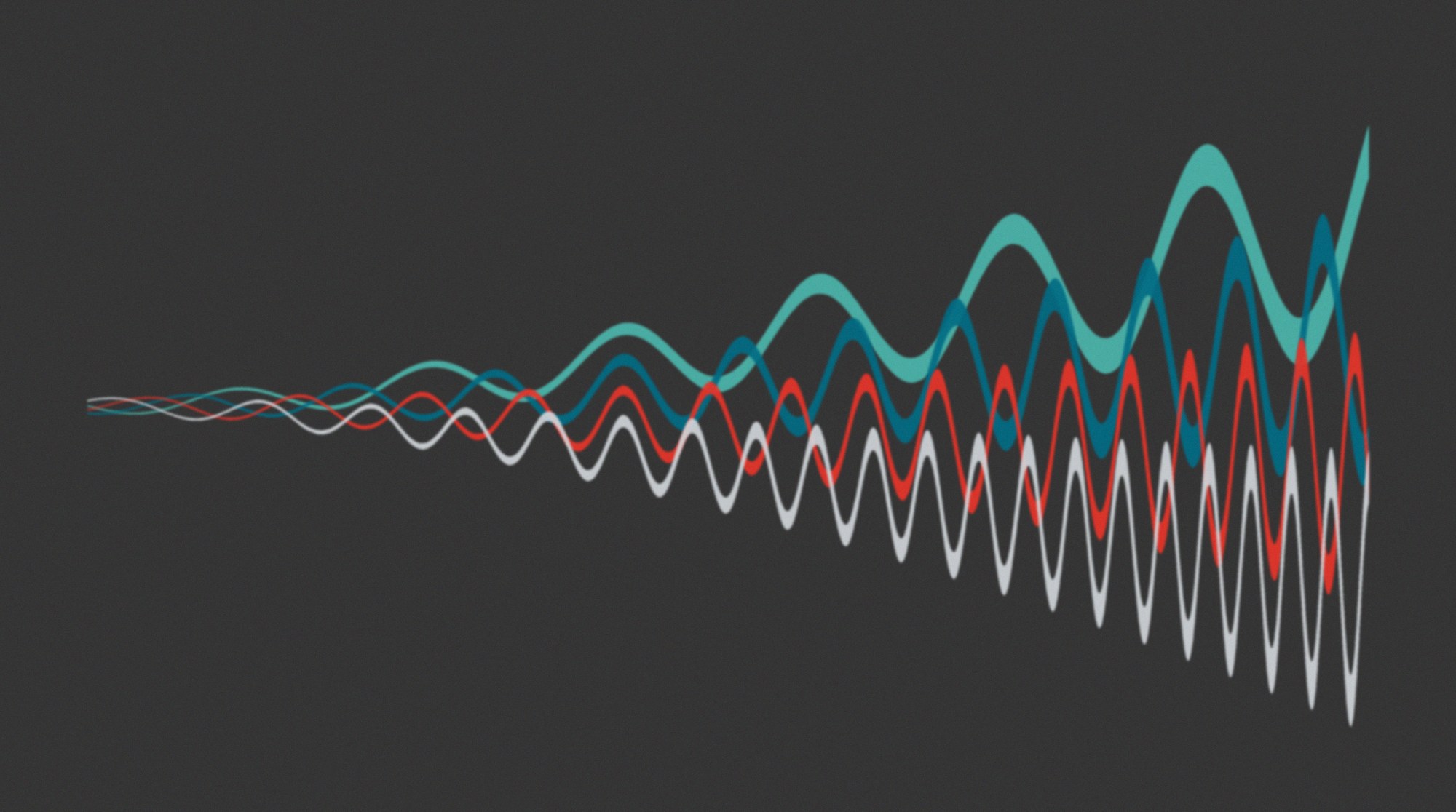
Melissa McCracken is an American painter, and many of her canvases are portraits of songs. Not the album cover, not the singer: the song itself. One is called Life on Mars, after David Bowie's track, and it is made of swirls and currents of colour that would look abstract to anyone else. To her, it is a faithful likeness.
McCracken has synaesthesia: a stimulus reaching one sense also switches on a perception in another. In her case sounds turn into colours, a form with a name of its own, chromesthesia.
How rare is it?
When I first wrote this piece in 2017, I said synaesthesia affects 4% of the population. The number holds, but it needs reading carefully. It comes from a 2006 study led by Julia Simner, which screened hundreds of people for every known variant (more than a hundred different pairings of senses) and found at least one in 4.4% of them. The most common forms have nothing to do with music: days of the week that have a colour, or letters of the alphabet. Those alone make up about half the total. People who see music in colour are a minority within a minority.
One more thing that is almost always true: the link runs one way. If a D looks blue to you, the sky will not sound like a D.
Duke Ellington's blue burlap
Musicians have told plenty of these stories. The loveliest is Duke Ellington's. In a 1958 interview he explained that the colour depended not on the note but on who played it. A D from Harry Carney was dark blue burlap. A G from Johnny Hodges turned into light blue satin. For a composer who wrote for the individual players in his band before he wrote for their instruments, it is almost a statement of method.
Closer to our time, Pharrell Williams has said he knows a track is in the right key because the colours match, and that Happy has always been yellow and red to him. Billie Eilish says she built her videos and live shows on the colours she sees for each song (her father and her brother Finneas have synaesthesia too). Whether it really helps anyone write is not proven. That the people who have it put it to work, clearly is.
Can it be learned?
The usual explanation is a set of connections between brain areas that normally get pruned as we grow up, and that in synaesthetes survive. Since 2017, though, it has become clear that learning plays a bigger part than we thought.
The original article blended two different studies, so here they are separately. In 2012, at the University of Amsterdam, Olympia Colizoli and her colleagues had a group of people read novels in which certain letters were always printed in the same colour. After a whole book, the readers had started pairing those letters with those colours automatically. It was not real synaesthesia, but it shared some of its traits.
A year later in the United States, Nathan Witthoft and Jonathan Winawer studied eleven genuine synaesthetes who had always seen letters in colour. Their colours matched, strikingly, the Fisher-Price magnetic fridge letters that nearly all of them had owned as children: red A, yellow C, green D. The predisposition was theirs. The toy had picked the palette.
And in 2014, at the University of Sussex, a group of adults reported "seeing" colours for letters outside the exercises after nine weeks of training. For most of them the effect faded a few months after the course ended.
The painter who listens to colour
Then there is a case that is almost synaesthesia in reverse. Neil Harbisson was born with achromatopsia: he sees the world in greyscale. Since 2004 he has worn an antenna on his head with a sensor that reads the colour in front of him and turns it into a sound, which he hears through the bones of his skull. Every colour has a frequency. Over time he started going the other way too: he paints voices and famous speeches, and a trip to the supermarket works like a concert.
What about you?
In 2017 I ended the article with an online test from UC Berkeley that promised to tell you whether you were a synaesthete. The page is gone, but the study behind it is not, and it is more interesting than the test. In 2013 Stephen Palmer's group played classical music to people with no synaesthesia at all, in the United States and in Mexico, and asked them to choose the colours that went best with each piece. Fast pieces in a major key landed on bright, light yellows; slow ones in a minor key on dark blues and greys. The same in both countries.
The bridge, the researchers argue, is emotion: a cheerful piece and a bright yellow make us feel the same way, so the brain files them together. That is not synaesthesia. But it does mean that we all hear a little colour in music.
_This article is a 2026 revision of a piece first published on Medium in September 2017._
Alessandro Porri
More of these, here.
All articles →