
Perfect pitch
Are you born with it, or can you learn it?
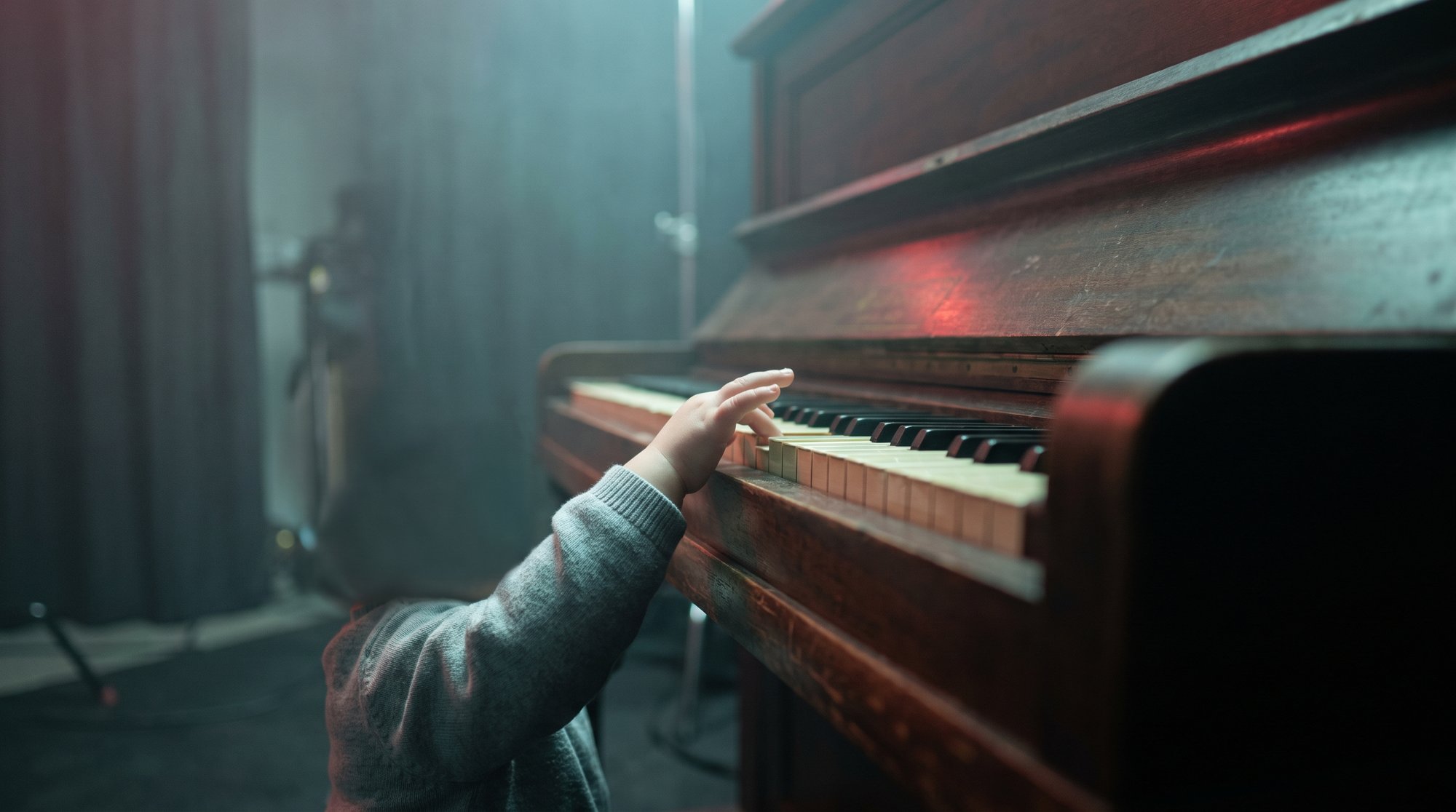
Dylan Beato was nine when his father Rick, an American musician and producer, sat him near a piano in front of a camera. Rick plays clusters of dissonant notes, put together precisely so they make no harmonic sense. Dylan, with his back to the keyboard, names them one by one, almost instantly.
Dylan has what's called perfect pitch, or absolute pitch: the ability to identify a note with no reference at all.
Absolute and relative
To see why it's rare, you have to separate it from its close relative, relative pitch. If I play you an A and tell you it's an A, a trained musician can work out the following notes by recognising the intervals, the distances between one note and the next. It's an essential skill for players, because it's what makes improvisation possible, and it's common among people who simply listen to a lot of harmonically rich music, like jazz or classical. That's why the two get confused.
Someone with perfect pitch doesn't need that first A. They recognise it on their own, and every note after it.
How many people, really
In the 2017 version of this article I wrote that fewer than 30% of the world's population has perfect pitch. That was wrong, by a long way. The figure quoted for decades is one in ten thousand; it's an old estimate and probably too low (a 2019 review finds at least 4% among music students), but the order of magnitude holds: this is rare.
Rare, though, not equally rare everywhere. In 2006 the psychologist Diana Deutsch compared students at two conservatories, one in the United States and one in Beijing. Among those who had started music lessons at four or five, about 60% of the Chinese students had perfect pitch, against 14% of the Americans. Among those who had started at eight or nine, it was 42% of the Chinese students and none of the Americans.
The difference isn't in the genes, it's in the language. Mandarin is a tone language: the same syllable changes meaning depending on the pitch you say it at. A child growing up with Mandarin learns in their first months that the pitch of a sound means something, and their brain holds on to it.
Neither inborn nor learnable. Almost
For years the debate had two camps: perfect pitch is a gift you're born with, or a skill anyone can build with enough study. Neither held up.
The explanation that has lasted longest is the critical period. In the first years of life the brain is growing fast and listening to everything: a newborn can tell apart the sounds of any language in the world before narrowing in on the ones spoken around them. The absolute pitch of a note would be one of those sounds. If nothing makes it matter (and a tone language, or early music lessons, do make it matter), the brain learns to do without it and relies on intervals instead.
(In 2017 I wrote that the window closes within the first year of life. Deutsch's data say otherwise: it stays open for a few years and narrows as you grow.)
The brain learns an alphabet
One detail makes all this stranger. Notes aren't facts of nature; they're conventions. In today's Western music, with equal temperament, the twelve notes are evenly spaced, and an A sharp sounds exactly like a B flat. In Pythagorean or meantone tuning they don't: they're two different notes.
So someone with perfect pitch isn't recognising a "true" frequency. They're recognising the notes they learned. A person with perfect pitch in the eighteenth century and one today would name the same notes on different frequencies, because temperaments have changed since, and so has the reference A (I wrote about that in the piece on the exact note). In theory, a child raised only on Pythagorean music would develop Pythagorean perfect pitch. All you'd need is a few records cut in Croton in the sixth century BC (a bit scratched, but think of that vintage sound).
It's a bit like learning one alphabet rather than another: same ideas, different letters.
The Dylan case
Back to Dylan. His father says he played him harmonically rich music every day, from before he was born until he was two, and later turned the method into a programme for young children called Nuryl. It's a single case, and a video isn't a study. But it fits the critical-period idea: an ear exposed early, and for a long time, to sounds whose pitch matters.
And as an adult?
This is the part I couldn't write in 2017. For a long time the answer was that adults don't acquire perfect pitch: you can improve your relative pitch enormously, but that window is shut.
In 2019 a team at the University of Chicago published a study whose title says it all, Absolute pitch can be learned by some adults: after intensive training, some participants performed indistinguishably from people who had always had it. In 2025 another study, led by Yetta Wong at the University of Surrey, trained twelve adult musicians online for eight weeks. On average they learned to identify seven of the twelve notes with at least 90% accuracy. Two of them got to all twelve, as fast and accurate as people born with it.
Two out of twelve isn't a rule. But it shifts the question this article started with: maybe it's not whether perfect pitch is inborn or learned, but how much it costs to learn, and at what age it costs least.
_This article is a 2026 rewrite of a piece first published on Medium in September 2017._
Alessandro Porri
More of these, here.
All articles →