
The exact note
Why the standard is 440 Hz
When you tune an instrument, you lean on a shared frequency agreed in advance: without one, two instruments could never play together. Any electronic tuner today will set an A to vibrate at 440 Hz — 440 cycles per second. The A above middle C, to be exact (A4).
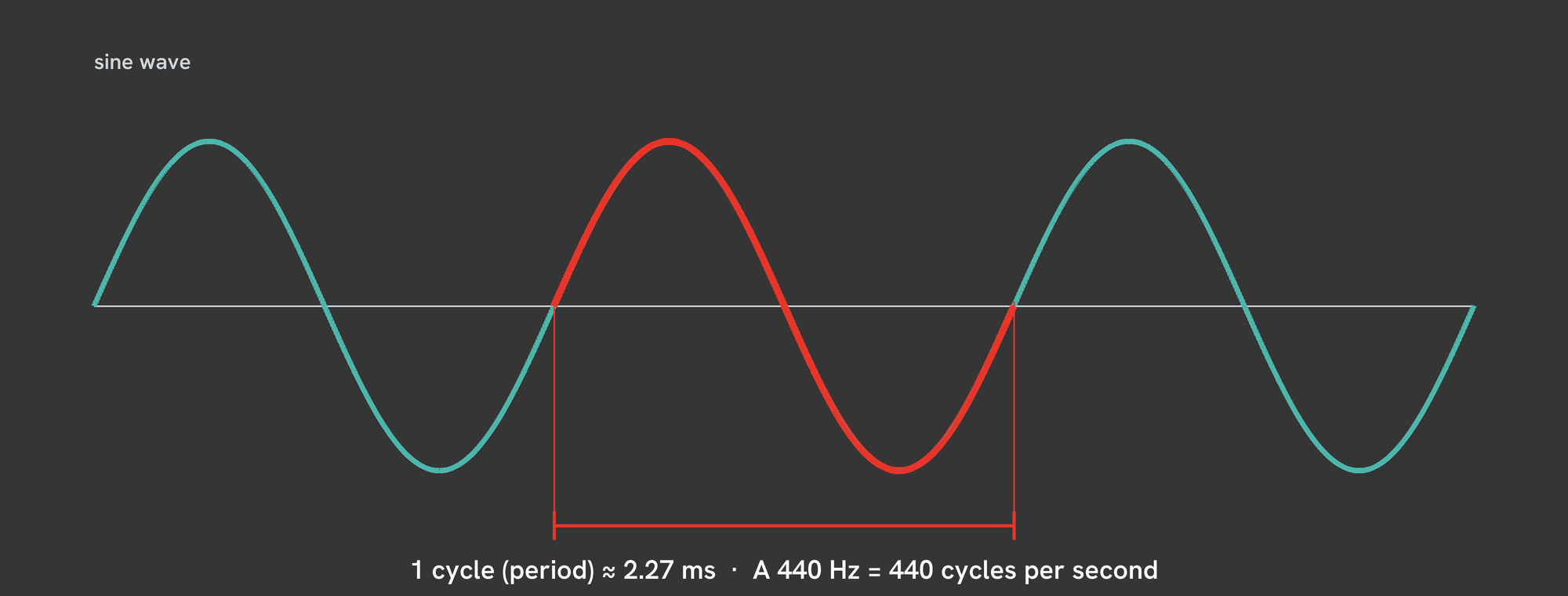
But who decided on that frequency, and why that one?
Those questions have been circulating online for years, along with answers of every kind and some heated debates — like whether tuning to 432 Hz is more "natural" than 440. Let's step back first.
Before, everyone had their own A
Until the eighteenth century there was no recognised way of tuning: the lead instrument of the ensemble played a reference note and the others matched it. The instruments were in tune with each other, but one day the group played at one pitch and the next day at another.
The first attempt at a fixed reference was the tuning fork, invented in 1711 by the English trumpeter John Shore: for the first time you could have a reference note that didn't drift with temperature or with whoever played it. The value you gave it was still a choice, though, and every fork carried the taste of the person who made it. Handel's, from 1740, measures 422.5 Hz; Beethoven's, from around 1800, 455.4 Hz — more than a semitone apart.
Over time composers and players came to prefer higher pitches, brighter and more defined, and the A kept creeping up. The people who paid for it were the singers, who unlike an instrument can't change their range. It was to protect voices that in 1859 France set the first common value by law: 435 Hz, the diapason normal.
Verdi and 432 Hz
Giuseppe Verdi went the other way: he wanted a lower A, for the same reasons the singers did, and in 1884 an Italian War Ministry decree set 432 Hz for every orchestra and military band. The following year, at the music congress in Vienna, Europe chose the French 435 instead. That's where the "Verdi's 432 Hz" story you'll find online comes from: the historical part is true; what often gets added — that 432 is the universe's "natural" frequency — has never been demonstrated by anyone.
How we got to 440
The idea of 440 Hz is much older than you'd think: as early as 1834 the German acoustician Johann Heinrich Scheibler proposed it, with the backing of a scientific society in Stuttgart. But the A people actually played stayed something else for decades: English piano tuners, for instance, had settled on 439 Hz.
It was industry that made 440 win. In 1926 the American music industry informally agreed on that value, and as instruments went into mass production in the United States it became the reference A for the people making them; in 1936 the American Standards Association recommended it officially. In May 1939, in London, delegates from several European countries and the US adopted it internationally.
Why not 439? One of the reasons given at the time is almost comic: 439 is a prime number, awkward to divide into the frequency ratios of equal temperament — the system we still use in Western music — while 440 factors neatly and is easier to reproduce in a lab with an electronic oscillator.
In 1955 the International Organization for Standardization (ISO) confirmed 440 Hz, and in 1975 the value was formalised as ISO 16.
A convenient number, not a correct one
So it's only recently that we've reached a precise, universal value for tuning — without ever really answering the original question. 440 Hz is the result of several factors: the industrial spread of instruments, and the search for a number that divides easily.
It's natural that lower frequencies feel easier for singers and come across as "warmer" (it's why a bass sounds full), and that higher ones sound brighter, or shrill. But no value has more claim than another.
If you think about it, it's exactly like the definition of the second, which today is:
the duration of 9,192,631,770 periods of the radiation corresponding to the transition between the two hyperfine levels of the ground state of the caesium-133 atom.
Until 1960 the second was defined by the Earth's rotation, then by its orbit around the Sun; only since 1967 has it been tied to the caesium atom, and in 2019 the definition was rewritten by fixing the numerical value of caesium's frequency directly. Frequency itself, after all, is defined in cycles per second.
It's likely, then, that these values will be redefined again, more accurately still. The A you hear today, however "exact", is a convention: the best one we managed to agree on.
Alessandro Porri
More of these, here.
All articles →