
The sound of Blade Runner 2049
How you follow up a sound nobody has forgotten
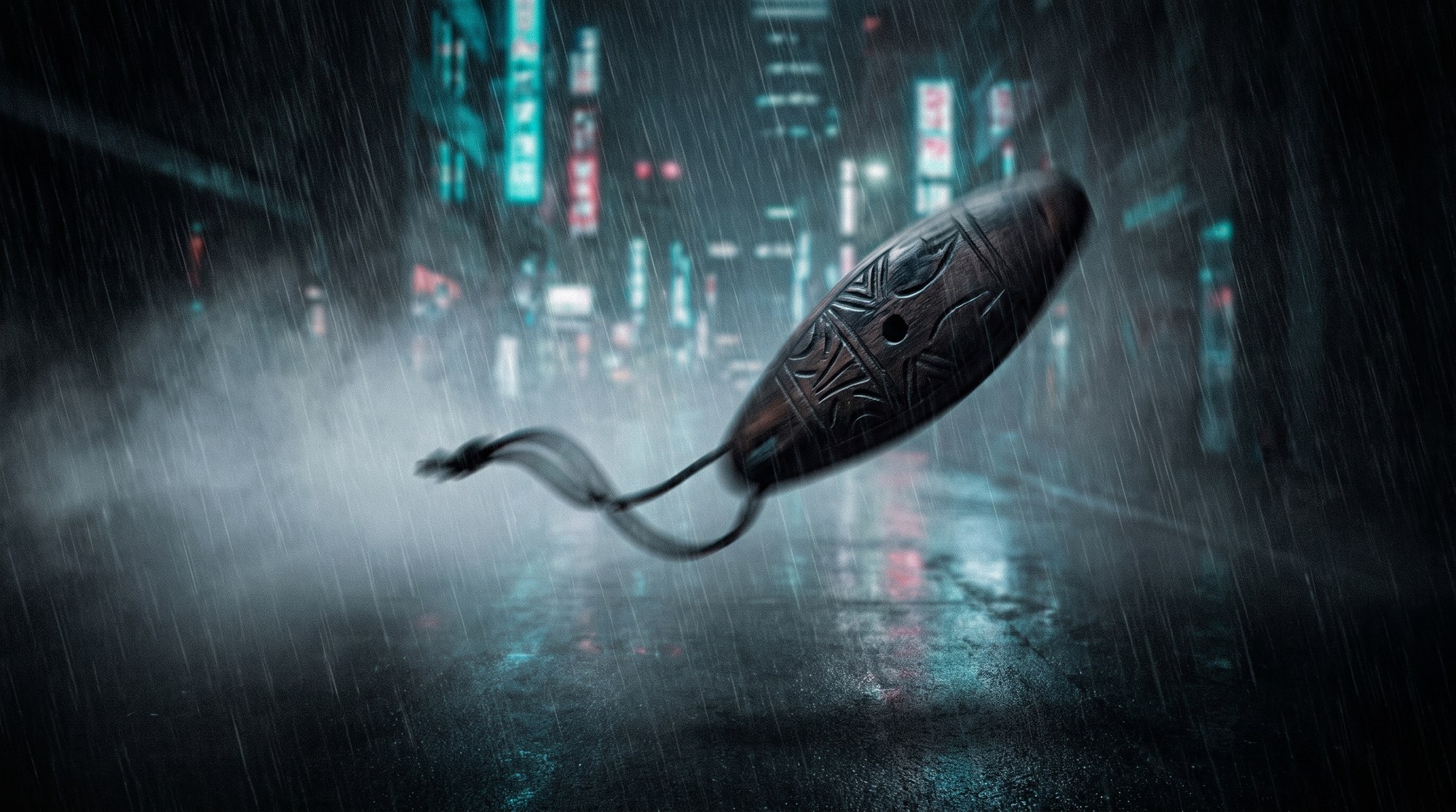
To make a spinner (the flying car in Blade Runner 2049) fly, they didn't record an engine. They took a bullroarer: a flat slat tied to a cord that, swung overhead, produces a low, vibrating hum. Then they put a subwoofer inside a Honda Element and recorded the vibrations of the bodywork. The rest is manipulation: a bullroarer worked until it sounded like an impossible manoeuvre.
The logic of Mark Mangini, the supervising sound editor, was simpler than it sounds: a spinner spins, so look for sounds that spin. It's free association, not physics. And it worked.
But how do you follow up a film that gave a whole future its sound back in 1982?
The problem is called Vangelis
The first Blade Runner, in 1982, came out of the Philip K. Dick novel Do Androids Dream of Electric Sheep? Vangelis played its score mostly on a Yamaha CS-80, an analogue synthesizer from the late 1970s: the size of a piece of furniture, with a pressure-sensitive keyboard that let you bend notes almost like on a violin. What came out couldn't quite be told apart from atmosphere: an atmosphere that, thirty-five years on, anyone recognises from the first note.
For the sequel the score was meant to be by Jóhann Jóhannsson, the Icelandic composer who had already worked with Denis Villeneuve on Sicario and Arrival. A few weeks before release, Hans Zimmer and Benjamin Wallfisch were there instead: Villeneuve explained he needed to go back to something closer to Vangelis's soundtrack. And that's where the CS-80 came back: the same instrument, forty years later, like a signature put under a new document.
Where does the music end?
The most interesting part, though, isn't in the score. In the first film music and effects touch constantly: the line between a synth pad and the noise of a breathing city isn't there, and Vangelis was working right in that in-between. Theo Green, 2049's sound designer, noticed it by studying the recordings from the time, a bootleg included: a good part of that material is texture, not melody.
The sequel went after the same fusion, but with the opposite method to an effects library: according to Mangini, there isn't a single sound in the film taken from an archive or from the earlier picture. Green spent three months on set in Budapest (unusual for a sound designer) and nine months of post-production in Los Angeles went into building, piece by piece, what has been described as musical sound effects: effects doing an orchestra's job, which is to create atmosphere.
It was nominated for an Oscar for both sound editing and sound mixing (both statuettes went to Dunkirk; the film won two, for cinematography and visual effects). But the thing to keep is something else: in a film like this, the sound designer and the composer are working on the same material, and the work that succeeds is the one where you can no longer tell who did what.
You'll notice how rare that is the next time you watch a film and can't say whether a sound was written by someone or recorded.
Alessandro Porri
More of these, here.
All articles →