
The power of sound
When it heals, and when it hurts
Robert Gupta is a neurobiologist on loan to the violin, or maybe it's the other way around: today he plays with the Los Angeles Philharmonic, but he trained in neurological research before choosing the orchestra. In a TED Talk of his, he tells a few stories of patients whose physical and mental condition improved sharply just by listening to music.
One example: a man who, after an accident, could no longer speak, because the language area of his brain — in the left hemisphere — had been damaged. Through steady, guided listening (music therapy), that function began rebuilding itself in the right hemisphere, the one left intact.
It's just one of many cases where music turned out to be decisive in rehabilitating patients with deficits caused by accidents or illness. Given how few side effects it carries, entire schools of thought have grown up around new music-therapy techniques, each tuned to a specific kind of problem.
How sound actually interacts with your body
The human auditory system is a strange, complex piece of machinery. In short: sound waves are funneled, thanks to the shape of the outer ear's cartilage, toward the eardrum and the three tiny bones (hammer, anvil, stirrup) that make up the middle ear. Their vibration moves the hair cells of the cochlea — the inner ear — which turn that motion into chemical signals for the auditory nerve, which then carries the information to the brain for final decoding.
A damaged cochlea can today be replaced with a cochlear implant; but given how intricate that chain is, the surgery never fully restores normal hearing. Someone with an implant doesn't perceive every frequency, or perceives some of them shifted — sometimes by as much as a semitone. Some implant recipients can no longer tell a violin's timbre from a trumpet's: to their ears, the two instruments start to sound almost like one.
The flip side of that same delicacy
That same complexity is also a weak point, and the protesters in Pittsburgh found out the hard way in 2009: during the G20 summit, local police deployed an LRAD, a sonic device able to project sound up to 150 decibels — roughly the noise of a jet at takeoff, one meter away — audible from nearly three kilometers out. The human pain threshold sits around 120 decibels: at 150, eardrums can be permanently damaged, and the sound vibrations themselves can reach other organs too.
It isn't only used for crowd control. The European Space Agency's ESTEC centre in Noordwijk, the Netherlands, houses an acoustic chamber (the Large European Acoustic Facility) capable of producing up to 154 decibels, used to test how well satellites survive the noise and sound pressure of launch.
So — silence, then?
At this point it's tempting to think nothing beats a bit of silence. Not quite: total silence can be just as harmful as noise.
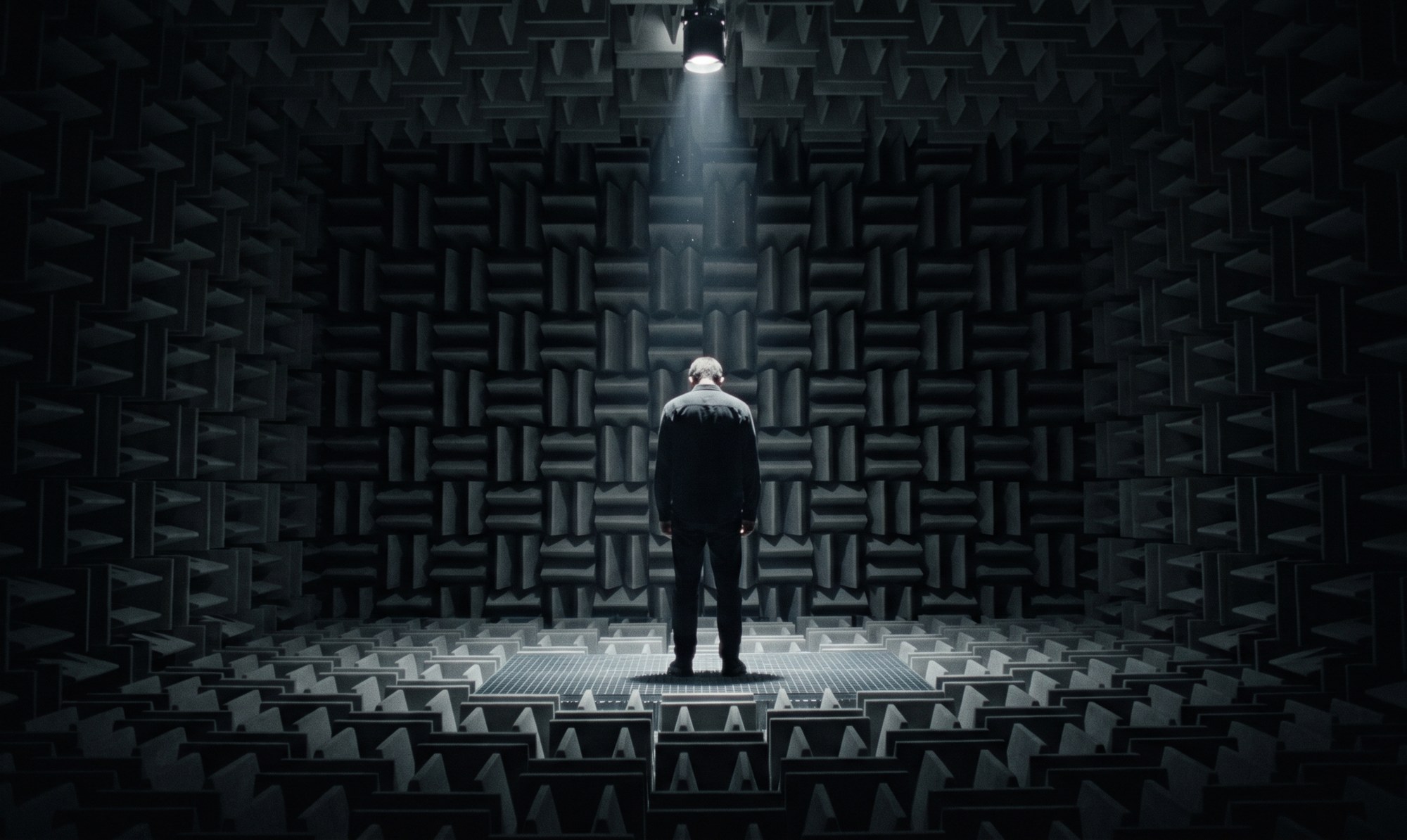
The anechoic chamber is an artificial room, purpose-built to test product sound and to study patients with hearing conditions. Thanks to special sound-absorbing materials, it reaches roughly -9 decibels inside. Read that again: not zero — minus nine. Which means the only source of noise left is you: you hear the blood moving through your veins, the air entering and leaving your lungs. Stripped of every other reference point, the brain starts inventing its own — some people have walked out after only a few minutes, hit by panic attacks or hallucinations.
Two takeaways close the loop. The first: the middle ground is almost always the right one. The second, more serious one: sound holds real power over behaviour and perception — sometimes without you ever noticing.
Alessandro Porri
More of these, here.
All articles →